1.7°C Below Dew Point: What a Tribunal Surveyor Saw That the Landlord Didn't
Every so often a tribunal decision reads like a lesson in inspecting for defects. In October the First-tier Tribunal for Scotland (Housing and Property Chamber) issued its decision in FTS/HPC/RP/26/0647. It’s a private rented flat, not social housing. But the inspection the tribunal’s surveyor carried out is exactly the sort of investigation we should now take note of.
You can read the full written decision and the enforcement order yourself if you would like more context. Below is my take on what went on.
The problem
The property is a three-bedroom flat on the top floor of a four-storey purpose-built block, thought to date from somewhere between 1965 and 1975, with a flat roof. Anyone who has managed that type of stock will already have a fair idea where this is heading.
The tenant listed twelve complaints. These included mould in all rooms, a rotten bath surround, a cracked bath, broken kitchen units, broken floor tiles, draughty windows, and the electrics tripping whenever the oven was switched on. Repairs had been reported to the landlord on and off from September 2023, and the council’s environmental health officer had also been in touch about them. By the time of the tribunal inspection in September 2026, the mould was heavy, especially on the bathroom and rear bedroom ceilings.
The landlord’s side had a theory of its own. In its written submission, the letting agent said the external cladding was causing the damp and mould, and that the property factor had instructed a surveyor to look at it. The cladding was in a poor state and the tribunal ordered work to it. But the cladding wasn’t what the tribunal’s surveyor found to be driving the mould.
The surveyor took a more thorough approach which uncovered other issues at hand.
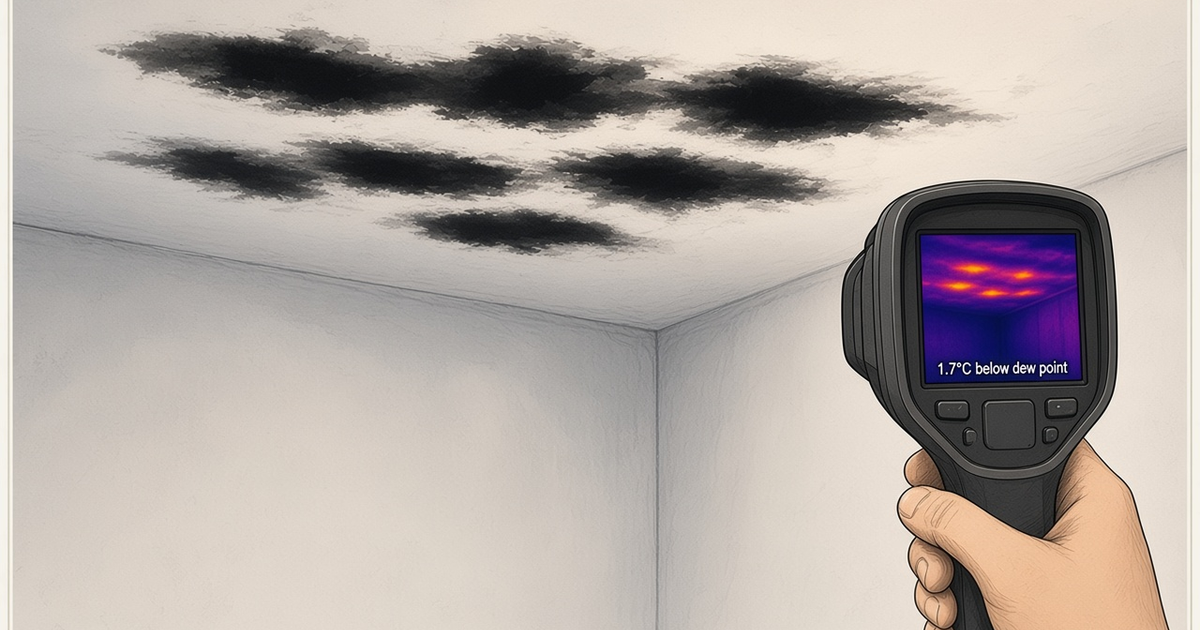
1. Dew point versus surface temperature. The environmental conditions in the flat were recorded and compared with the ceiling surface temperatures. Both the rear bedroom and bathroom ceilings were 1.7°C below dew point. In other words, active condensation was forming on the ceilings during the inspection, on a dry, bright morning.
If you haven’t done this yourself, it’s simple. You record the air temperature and relative humidity, which gives you the dew point. Then you take the surface temperature with an IR thermometer or a thermal camera. If the surface is at or below dew point, water is condensing on it right then. It’s giving you that active condensation risk you can put in a report.
2. Reading the mould pattern, this was the interesting part. On the rear bedroom ceiling, the surface was warmer along the line of the timber joists, and there was no mould directly below each joist. The mould grew in the bays between them.
Joists can sometimes act as the cold bridge and the ceiling gets pattern staining along the joist lines. When the joists are the warm strips, the timber is giving better thermal resistance than whatever fills the gaps between it, which usually means there’s little or no effective insulation in those bays. The flat’s own EPC from 2023 backed this up: it rated the flat roof’s energy efficiency as “poor” and recommended more insulation. The tribunal found the house didn’t meet the tolerable standard for thermal insulation.
3. Ventilation. There was no mechanical extract in the bathroom. The kitchen relied on a recirculating cooker hood with a carbon filter, which takes out grease and smells but not moisture. And there were no apparent trickle vents on any of the windows. So the moisture had nowhere to go apart from the coldest surface in the flat: the ceiling under the flat roof.
4. The hidden water. The bath had dropped by roughly an inch and the silicone at the wall was completely open. When the surveyor moved the split bath panel, there was clear evidence of water escaping onto the timber floor. Moisture meter readings showed the timbers were beyond fibre saturation point, with decay already starting. The tribunal described the bathroom floor as unsafe, especially around the WC, and told the tenant to keep bathroom use to a minimum until it was fixed.
That leak wasn’t just a repair in its own right. It was adding to the moisture load in the house and feeding the mould on the ceilings.
Putting it together, the surveyor member’s view was that the mould was primarily caused by:
- insufficient insulation in the ceiling,
- inadequate trickle ventilation and mechanical extract, and
- the extra moisture load from the ongoing water escape in the bathroom.
So that’s three causes, and in this case none of them was the cladding.
Where it went wrong
Treating the symptom. There’s a small example in the decision that I think sums this up. The tenant had complained about water coming in at the base of the rear bedroom window. The internal sill had been resealed. But outside, the timber panelling below the window was decayed, with voids and failed sealant, which left open moisture paths. The inside looked fixed and the outside was still letting water in.
Blaming the cladding wasn’t unreasonable as a first thought, and the cladding did need replacing. But it led to the issue being passed to the property factor (only as recently as September 2026, the decision notes) instead of someone measuring what was going on inside the flat. A walk-round with a hygrometer and a surface thermometer would have pointed at the roof, the ventilation and the bath far sooner. This is why when we carry out damp surveys it has to be a holistic approach and even if there are other factors outwith our control it’s on us to ensure we tackle everything within our remit.
The agent’s submission accepted the problems and said the landlord was “not currently in a financial position to undertake all of the works simultaneously”. It was looking at phasing, alternative quotes and so on. It also pointed out that the rent was comparatively low for the area. The tribunal was clear on both. Quotes had been in hand for more than eight months. The duty to meet the repairing standard applies at all times “regardless of his financial position”. And the level of rent is “irrelevant” to that duty. Social landlords should take note of that too: budget pressure doesn’t change what the standard requires.
To be fair, not everything went against the landlord. The fixed electric heaters were working and passed. The tribunal noted several were blocked by furniture, which might explain why the heating didn’t feel adequate. An interlinked smoke and heat detection system had been installed and met the standard, and the earlier electrical faults with the lights and face plates had been repaired. So not a completely reckless landlord but some major failings none the less.
The outcome
The tribunal issued a Repairing Standard Enforcement Order with 14 items, to be completed within five months. The damp and mould items are worth noting because they read like a decent specification:
- Strip the mould-contaminated plasterboard ceilings in the rear bedroom and bathroom, add insulation to the ceiling void, then re-board, clean and decontaminate before redecorating.
- Install humidistat-controlled mechanical extract in the bathroom, extracting at least 15 l/s.
- Provide kitchen extract ducted to outside air: 30 l/s if it’s over the hob, or 60 l/s if it’s elsewhere.
- Fit controllable trickle vents to the kitchen, bathroom and rear bedroom windows as a minimum.
- Open up the bathroom floor, dry it out, replace any decayed joists or framework and wet insulation, and relay it in moisture-resistant chipboard.
- Repair the decayed external timber panelling below the rear bedroom window and reseal it.
Conclusion
This was a classic top-floor flat under a cold flat roof. Low ceiling temperatures, no extract, no trickle vents and a hidden leak all added up to heavy mould. None of it was hard to find. It just needed someone to measure instead of guess.
For those of us in social housing, the timing is the point. Since 6 October 2026, Scottish landlords, social and private, have had to complete a damp and mould investigation by a competent person within 10 working days and give the tenant a written summary. This case was reported before that date, so the new timescales didn’t apply to it. But the tribunal’s inspection is a good model for what that investigation should look like:
- Take air temperature, RH and surface temperatures, and work out the dew point.
- Read the mould pattern. Where it grows, and where it doesn’t, tells you about the structure behind it.
- Check the ventilation.
- Look for hidden water, and use a meter on the timbers.
A thermal camera on its own will tell you a surface is cold, but not why. Pair it with humidity readings and a moisture meter and you have evidence, and that’s what goes in the written summary.
1.7°C doesn’t sound like much. But it was enough to tell the tribunal what the landlord hadn’t worked out in three years of complaints.
Case: First-tier Tribunal for Scotland (Housing and Property Chamber), FTS/HPC/RP/26/0647, written decision and RSEO dated 8 October 2026. Case page.